Choosing a Deer Rifle Calibre: Range, Recoil and What Your State Allows
Deer have been killed cleanly with every centerfire cartridge ever made, which is why the calibre argument never ends. The useful question is not which cartridge is best but which one fits the way and the place you hunt: the distances, the size of the deer, how much recoil you shoot well, what ammunition your local store keeps on the shelf, and what your state allows. This guide sorts the common choices by those tests and ends with a short list.
What a deer cartridge has to do
A whitetail is a thin-skinned animal weighing between ninety and two hundred and fifty pounds. Any bullet of reasonable weight and construction that arrives with fifteen hundred foot-pounds or so of energy and expands reliably will kill one quickly with a good hit. The cartridges below all do that to at least two hundred yards, and most to three hundred. Past that, the shooter's ability to place the bullet in a six-inch circle in field conditions matters far more than the cartridge.
The light recoilers
The .243 Winchester is the classic light deer rifle: flat-shooting, mild in recoil, ideal for young and small-framed hunters and for anyone who values a second accurate shot. With a hundred-grain bullet it is a two-hundred-and-fifty-yard deer cartridge. The 6.5 Creedmoor has taken over much of the .243's territory with more bullet weight and a better selection of hunting loads; it recoils a little more and shoots flatter at distance. The 7mm-08 Remington sits between the two and .308 in recoil and is one of the best all-round deer cartridges made, though ammunition is less common on rural shelves.
The standards
The .308 Winchester and the .30-06 Springfield are found in every gun shop in the country. Both fire heavier bullets than the light recoilers, both handle deer to three hundred yards with ease, and both step up to elk and black bear. The .308 fits in a short-action rifle and recoils a little less; the .30-06 carries more velocity with the heaviest bullets. For a first deer rifle that may also hunt bigger game, either is the answer, and .308 ammunition is the cheaper of the two to practise with. The .270 Winchester is their flat-shooting cousin, a superb open-country deer cartridge with recoil close to the .308.
The magnums
The .300 Winchester Magnum and 7mm Remington Magnum add velocity and reach at the cost of recoil that most hunters do not shoot as well as they think. They are elk and long-range cartridges; for deer inside three hundred yards they add nothing but noise and a flinch. Buy one if you also hunt elk in open country and shoot enough to master it.
The straight-walls
Ohio, Iowa, Indiana and southern Michigan limit deer rifles to straight-walled cartridges, and the market has answered. The .350 Legend is a mild, accurate cartridge good to two hundred yards that recoils like a .243 and works in both bolt rifles and AR-platform rifles. The .450 Bushmaster hits much harder, recoils accordingly and is the choice for big northern deer at ranges under two hundred yards. The old .45-70 remains legal and effective in lever guns. If you hunt in a straight-wall state, one of these is your deer rifle whatever else you own.
Lever-gun calibres
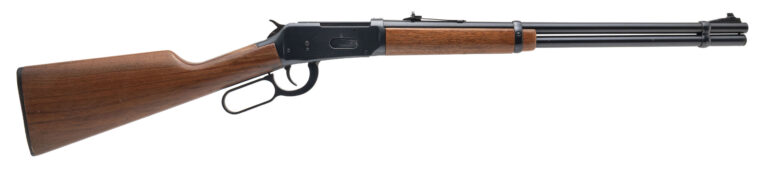
The .30-30 Winchester has killed more deer than any cartridge in America and still does the job inside a hundred and fifty yards in the timber. The .35 Remington and .45-70 are its bigger cousins. A lever gun is light, quick and legal everywhere, and in thick cover it is hard to beat.
Ammunition availability
A cartridge is only as good as the shelf it comes from. In a small-town hardware store in November you will find .30-30, .243, .270, .308, .30-06 and 6.5 Creedmoor almost without fail, and .350 Legend in the straight-wall states. You will not reliably find 7mm-08, the various short magnums or the newer 6.5 and 6.8 designs. If you hunt far from home or tend to run short, choose a cartridge the local store keeps in three brands; if you handload or buy a season's supply in advance, choose whatever shoots best in your rifle.
Recoil and the rifle
Recoil is a function of cartridge and rifle weight together. A .308 in a seven-pound rifle is pleasant; in a five-and-a-half-pound mountain rifle it is not. A shooter who flinches will miss with any calibre, so buy the cartridge you will practise with. Muzzle brakes tame recoil at the cost of blast; a good recoil pad and a rifle of sensible weight do the same more quietly.
Bullets
Modern bonded and monolithic hunting bullets have made every cartridge on this list more effective than it was twenty years ago. For deer, a standard soft-point or a bonded bullet in the middle weight for the calibre is ideal; premium controlled-expansion bullets built for elk can fail to open on a small deer at modest velocity. Buy two boxes of the same load, sight in with one and hunt with the other.
A short list
- Young, small or recoil-sensitive hunters: .243 Winchester or .350 Legend.
- One rifle for deer and the occasional elk: .308 Winchester or .30-06.
- Open country and long shots: 6.5 Creedmoor or .270 Winchester.
- Straight-wall states: .350 Legend for most hunters, .450 Bushmaster for big deer.
- Thick timber and short shots: .30-30 in a lever gun.
Read the state rules guide for what your state allows and the scope guide before you spend the rest of the budget. Browse bolt-action rifles and lever-action rifles in the catalogue, and see your town's season on the city pages.
General information, not legal advice. Current as of September 2026. Laws change; check the official source before you act.